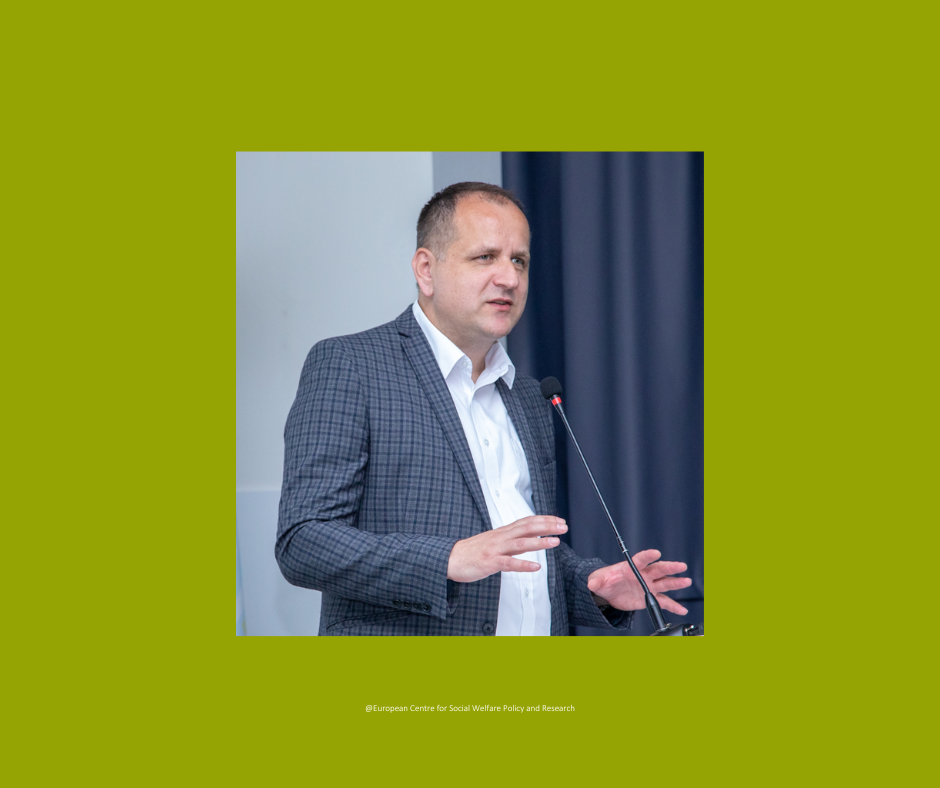
EESPN Spotlight: Nermin Oruc on Turning Evidence into Meaningful Policy Change in Bosnia and Herzegovina
In our latest EESPN Spotlight, Nermin Oruc, Director and Founder of the Centre for Development Evaluation and Social Science Research (CREDI), discusses how research and evidence can contribute to meaningful social policy change in Bosnia and Herzegovina. From tax and benefit micro-simulation and employment policies for foreign workers to capacity-building and evaluation, Nermin shares how CREDI works directly with institutions to turn research into concrete policy solutions. He also reflects on the importance of regional cooperation across the Western Balkans and the role of collaboration with the European Centre and EESPN in strengthening research capacity, knowledge exchange and quality standards. At the heart of his message is a strong belief in the expertise of the region and the importance of recognising progress, even when change is gradual: “Yes, we can.”
Nermin Oruc is the Director and Founder of the Centre for Development Evaluation and Social Science Research (CREDI) in Bosnia and Herzegovina, an organisation working at the intersection of social policy, labour markets, migration and education. Through research, technical assistance and capacity-building, CREDI works closely with institutions and other stakeholders to support the development of better policies and practices. Much of this work is grounded in a clear conviction: research should not remain disconnected from policymaking, but should contribute to concrete improvements in people’s lives.
“I believe that reducing inequalities and improving social policies is as important as improving the competitiveness of the country. Development is not only about growth; it’s about the improvement of the quality of life for people,” Nermin explains.
A key part of CREDI’s work is strengthening the evidence available to policymakers. For Nermin, understanding what data is available and making better use of it is an essential first step towards evidence-based policy design. At the same time, CREDI looks beyond existing data and historical trends to anticipate emerging policy challenges. One recent example is its work on a roadmap for improving the employment of foreign workers in Bosnia and Herzegovina. As the number of foreign workers is expected to increase, the research looked not only at simplifying employment procedures, but also at the wider implications for workers’ rights, access to social services and the rights of family members. “We try to not only analyse historical trends but also point towards trends and the need for policy design in a timely manner for what we can anticipate will be important policy issues,” Nermin says. The roadmap has already contributed to concrete changes. Procedures for foreign workers were simplified, including through strengthened cooperation between institutions, allowing residence permits to be issued through consular offices and reducing the need for workers to enter Bosnia and Herzegovina and then wait for extended periods for their permits. For Nermin, this demonstrates the value of research that involves institutions and other stakeholders throughout the process. “It’s not just disconnected research, but participatory research involving stakeholders, institutions, co-designing solutions with them has a good likelihood of being implemented.”
CREDI’s experience extends beyond migration and employment policy. Its micro-simulation models have been used to estimate the impact of taxation changes, with the resulting evidence contributing to proposals submitted to Parliament. The organisation has also worked with the Ministry of Finance on the design of specific provisions of new legislation. These experiences have reinforced Nermin’s belief that research can have its greatest impact when researchers remain engaged after the publication of a report and continue working with institutions to translate recommendations into practical solutions. “Research is part of the process,” he explains. Rather than seeing a research report as the end point, CREDI becomes involved in task forces and working groups supporting the implementation of evidence-based solutions. This can include helping institutions develop laws, bylaws and other concrete measures.
For Nermin, this commitment is particularly important in a context where evidence is not always automatically requested or used by national institutions. Much of CREDI’s work is initiated through cooperation with international organisations, which creates opportunities for local research organisations to bring evidence into policy processes. While he would like to see stronger institutional demand for research and more critical discussion of policy proposals, he remains convinced that evidence can influence policy even in difficult institutional and political environments. Bosnia and Herzegovina’s decentralisation and complex political context can make policymaking challenging, but, as Nermin puts it: “If you bring good evidence, good arguments to the table, there is still a possibility to have political will for implementation. It’s not easy, but it’s possible.”
Regional cooperation is another important element of CREDI’s work. The organisation participates in networks covering migration, labour markets and economic policies, and has worked with institutions across the region, including public employment services. For Nermin, regional collaboration provides an important opportunity to exchange knowledge and expertise while strengthening the capacity of the wider research community. He also sees the European integration process as an important driver of cooperation and reform in the region. At the same time, he stresses the importance of strengthening the capacity of local organisations themselves rather than relying exclusively on external expertise. This is one of the areas where collaboration with the European Centre and the European Social Policy Network (EESPN) has been particularly valuable for CREDI. “Any collaboration with stronger organizations from the EU is a useful experience where we gain new knowledge, where we improve our skills for writing proposals and implementing research projects,” Nermin says. He also highlights the role that organisations such as the European Centre can play in transferring European practices and standards to research organisations in candidate countries, including in areas such as quality assurance and compliance. Participation in European networks further provides opportunities for knowledge exchange and helps CREDI strengthen its independence and credibility. “I think it’s important for our organization, particularly for maintaining independence and credibility.”
Looking ahead, Nermin sees significant potential for further cooperation and capacity-building in the Western Balkans. One idea he would particularly like to see advanced is the development of a Western Balkan micro-simulation model, or “Balkan Mod”, which could provide an intermediate stage for countries in the region to build their capacities before fully joining the EUROMOD system.
Nermin’s commitment to social policy is also deeply personal. As an economist, he chose to focus on reducing inequalities and improving social policies rather than concentrating exclusively on economic growth and competitiveness. For him, development ultimately has to be measured by its impact on people’s lives. He also sees his work as a way of giving something back to his country. “I think it’s really a feeling of responsibility that we should give something back to our country. And I think, as somebody who works in research, the best way I can contribute to my country is by providing evidence and ensuring that policies are developed based on evidence.” Despite the obstacles facing researchers and institutions, Nermin believes that the Western Balkans have developed substantial expertise and should have confidence in their ability to contribute to high-quality policy research. His message is simple: “Yes, we can.”
He sees this message as applying both to institutions and to researchers. Institutions, he argues, should recognise the expertise available within the region, while researchers should not allow political or institutional difficulties to discourage them from continuing their work. Looking at the region over the past two decades, he sees considerable progress, even if many challenges remain. “We need to observe some small steps and realize that even these small steps are moving forward, and this should motivate us to continue our work.” For Nermin, evidence-based policymaking is therefore not simply about producing research. It is about building relationships with institutions, remaining engaged throughout the policy process, strengthening regional research capacity and ensuring that evidence ultimately contributes to better policies and better lives.